



Skip to content
  • Home
  • Aktuell
  • Tags
  • 0 Ungelesen 0
  • Kategorien
  • Unreplied
  • Beliebt
  • GitHub
  • Docu
  • Hilfe
Skins
  • Light
  • Brite
  • Cerulean
  • Cosmo
  • Flatly
  • Journal
  • Litera
  • Lumen
  • Lux
  • Materia
  • Minty
  • Morph
  • Pulse
  • Sandstone
  • Simplex
  • Sketchy
  • Spacelab
  • United
  • Yeti
  • Zephyr
  • Dark
  • Cyborg
  • Darkly
  • Quartz
  • Slate
  • Solar
  • Superhero
  • Vapor

  • Standard: (Kein Skin)
  • Kein Skin
Einklappen
ioBroker Logo

Community Forum

donate donate
  1. ioBroker Community Home
  2. Deutsch
  3. Off Topic
  4. Proxmox
  5. Showcase: SSD und HDD Gesundheitszustand überwachen

NEWS

  • Jahresrückblick 2025 – unser neuer Blogbeitrag ist online! ✨
    BluefoxB
    Bluefox
    16
    1
    1.3k

  • Neuer Blogbeitrag: Monatsrückblick - Dezember 2025 🎄
    BluefoxB
    Bluefox
    13
    1
    776

  • Weihnachtsangebot 2025! 🎄
    BluefoxB
    Bluefox
    25
    1
    2.0k

Showcase: SSD und HDD Gesundheitszustand überwachen

Geplant Angeheftet Gesperrt Verschoben Proxmox
bashcurls.m.a.r.tshowcase
5 Beiträge 2 Kommentatoren 533 Aufrufe 4 Watching
  • Älteste zuerst
  • Neuste zuerst
  • Meiste Stimmen
Antworten
  • In einem neuen Thema antworten
Anmelden zum Antworten
Dieses Thema wurde gelöscht. Nur Nutzer mit entsprechenden Rechten können es sehen.
  • MartinPM Online
    MartinPM Online
    MartinP
    schrieb am zuletzt editiert von MartinP
    #1

    Ich lese auf dem PVE-Hypervisor Linux per bash script im cron job S.M.A.R.T Parameter der System SSD und einer 4TB USB-HDD ein und schreibe per SimpleAPI einige mir interessant vorkommende Parameter nach "userdata". Alle 4 Stunden zur 11. Minute der Stunde werden die Werte aktualisert.

    S.M.A.R.T Ausgabe meiner USB-HDD


    root@pve:~/skripte# smartctl -a -d sat /dev/sdb
    smartctl 7.3 2022-02-28 r5338 [x86_64-linux-6.8.12-2-pve] (local build)
    Copyright (C) 2002-22, Bruce Allen, Christian Franke, www.smartmontools.org

    === START OF INFORMATION SECTION ===
    Model Family: Seagate BarraCuda 3.5 (SMR)
    Device Model: ST4000DM004-2CV104
    Serial Number: Z9703MW4
    LU WWN Device Id: 5 000c50 0a28fd89c
    Firmware Version: 0001
    User Capacity: 4,000,787,030,016 bytes [4.00 TB]
    Sector Sizes: 512 bytes logical, 4096 bytes physical
    Rotation Rate: 5425 rpm
    Device is: In smartctl database 7.3/5319
    ATA Version is: ACS-3 T13/2161-D revision 5
    SATA Version is: SATA 3.1, 6.0 Gb/s (current: 6.0 Gb/s)
    Local Time is: Mon Sep 30 17:40:12 2024 CEST
    SMART support is: Available - device has SMART capability.
    SMART support is: Enabled

    === START OF READ SMART DATA SECTION ===
    SMART Status command failed: scsi error unsupported scsi opcode
    SMART overall-health self-assessment test result: PASSED
    Warning: This result is based on an Attribute check.

    General SMART Values:
    Offline data collection status: (0x82) Offline data collection activity
    was completed without error.
    Auto Offline Data Collection: Enabled.
    Self-test execution status: ( 0) The previous self-test routine completed
    without error or no self-test has ever
    been run.
    Total time to complete Offline
    data collection: ( 0) seconds.
    Offline data collection
    capabilities: (0x7b) SMART execute Offline immediate.
    Auto Offline data collection on/off support.
    Suspend Offline collection upon new
    command.
    Offline surface scan supported.
    Self-test supported.
    Conveyance Self-test supported.
    Selective Self-test supported.
    SMART capabilities: (0x0003) Saves SMART data before entering
    power-saving mode.
    Supports SMART auto save timer.
    Error logging capability: (0x01) Error logging supported.
    General Purpose Logging supported.
    Short self-test routine
    recommended polling time: ( 1) minutes.
    Extended self-test routine
    recommended polling time: ( 478) minutes.
    Conveyance self-test routine
    recommended polling time: ( 2) minutes.
    SCT capabilities: (0x30a5) SCT Status supported.
    SCT Data Table supported.

    SMART Attributes Data Structure revision number: 10
    Vendor Specific SMART Attributes with ThBildschirmfoto vom 2024-09-30 19-24-36resholds:
    ID# ATTRIBUTE_NAME FLAG VALUE WORST THRESH TYPE UPDATED WHEN_FAILED RAW_VALUE
    1 Raw_Read_Error_Rate 0x000f 081 063 006 Pre-fail Always - 242543912
    3 Spin_Up_Time 0x0003 096 096 000 Pre-fail Always - 0
    4 Start_Stop_Count 0x0032 037 037 020 Old_age Always - 65535
    5 Reallocated_Sector_Ct 0x0033 100 100 010 Pre-fail Always - 0
    7 Seek_Error_Rate 0x000f 087 060 030 Pre-fail Always - 475250992
    9 Power_On_Hours 0x0032 039 039 000 Old_age Always - 54198h+57m+44.554s
    10 Spin_Retry_Count 0x0013 100 100 097 Pre-fail Always - 0
    12 Power_Cycle_Count 0x0032 100 100 020 Old_age Always - 28
    183 Runtime_Bad_Block 0x0032 100 100 000 Old_age Always - 0
    184 End-to-End_Error 0x0032 100 100 099 Old_age Always - 0
    187 Reported_Uncorrect 0x0032 100 100 000 Old_age Always - 0
    188 Command_Timeout 0x0032 100 099 000 Old_age Always - 1 1 1
    189 High_Fly_Writes 0x003a 100 100 000 Old_age Always - 0
    190 Airflow_Temperature_Cel 0x0022 071 049 040 Old_age Always - 29 (Min/Max 25/36)
    191 G-Sense_Error_Rate 0x0032 100 100 000 Old_age Always - 0
    192 Power-Off_Retract_Count 0x0032 100 100 000 Old_age Always - 279
    193 Load_Cycle_Count 0x0032 008 008 000 Old_age Always - 185700
    194 Temperature_Celsius 0x0022 029 051 000 Old_age Always - 29 (0 18 0 0 0)
    195 Hardware_ECC_Recovered 0x001a 084 064 000 Old_age Always - 242543912
    197 Current_Pending_Sector 0x0012 100 100 000 Old_age Always - 0
    198 Offline_Uncorrectable 0x0010 100 100 000 Old_age Offline - 0
    199 UDMA_CRC_Error_Count 0x003e 200 200 000 Old_age Always - 0
    240 Head_Flying_Hours 0x0000 100 253 000 Old_age Offline - 17864h+29m+54.542s
    241 Total_LBAs_Written 0x0000 100 253 000 Old_age Offline - 9900390920
    242 Total_LBAs_Read 0x0000 100 253 000 Old_age Offline - 10644847568

    SMART Error Log Version: 1
    No Errors Logged

    SMART Self-test log structure revision number 1
    No self-tests have been logged. [To run self-tests, use: smartctl -t]

    SMART Selective self-test log data structure revision number 1
    SPAN MIN_LBA MAX_LBA CURRENT_TEST_STATUS
    1 0 0 Not_testing
    2 0 0 Not_testing
    3 0 0 Not_testing
    4 0 0 Not_testing
    5 0 0 Not_testing
    Selective self-test flags (0x0):
    After scanning selected spans, do NOT read-scan remainder of disk.
    If Selective self-test is pending on power-up, resume after 0 minute delay.

    Interessant fand ich da Seek_Error_Rate und Raw_Read_Error_Rate

    Die entsprechenden Zeilen sehen so aus ...

    ID# ATTRIBUTE_NAME          FLAG     VALUE WORST THRESH TYPE      UPDATED  WHEN_FAILED RAW_VALUE
    ...
      1 Raw_Read_Error_Rate     0x000f   081   063   006    Pre-fail  Always       -       242543912
    ...
      7 Seek_Error_Rate         0x000f   087   060   030    Pre-fail  Always       -       475250992
    

    Interessant ist "VALUE", da der Wert "normalisiert ist, gilt, je höher, desto besser Maximum ist 100. Gibt den aktuellen Wert wieder.
    "WORST" ist da schlechteste jemals gemessene Wert.
    "THRESH" ist der Schwellwert, bei dem ein Defekt sehr nahe ist.

    Bei der SSD habe ich erstmal weniger Parameter angedacht, da fehlt womöglich noch etwas.
    An einigen Stellen differieren die Parameter, sodass die angedachte allgemeine Einlese-Funktion nicht möglich ist - schon für diese beiden Platten habe ich individuelle Funktionen bauen müssen...

    Hier die komplette Ausgabe der SSD


    smartctl 7.3 2022-02-28 r5338 [x86_64-linux-6.8.12-2-pve] (local build)
    Copyright (C) 2002-22, Bruce Allen, Christian Franke, www.smartmontools.org

    === START OF INFORMATION SECTION ===
    Model Family: Crucial/Micron Client SSDs
    Device Model: CT480BX500SSD1
    Serial Number: 2248E68B04B2
    LU WWN Device Id: 5 00a075 1e68b04b2
    Firmware Version: M6CR056
    User Capacity: 480,103,981,056 bytes [480 GB]
    Sector Size: 512 bytes logical/physical
    Rotation Rate: Solid State Device
    Form Factor: 2.5 inches
    TRIM Command: Available
    Device is: In smartctl database 7.3/5319
    ATA Version is: ACS-3 T13/2161-D revision 4
    SATA Version is: SATA 3.3, 6.0 Gb/s (current: 6.0 Gb/s)
    Local Time is: Mon Sep 30 15:43:51 2024 CEST
    SMART support is: Available - device has SMART capability.
    SMART support is: Enabled

    === START OF READ SMART DATA SECTION ===
    SMART overall-health self-assessment test result: PASSED

    General SMART Values:
    Offline data collection status: (0x00) Offline data collection activity
    was never started.
    Auto Offline Data Collection: Disabled.
    Self-test execution status: ( 0) The previous self-test routine completed
    without error or no self-test has ever
    been run.
    Total time to complete Offline curl $SimpleApiUrl$1"NormalizedReadErrorRate?value="$(awk '/Raw_Read_Error_Rate/{print $4}' Testdata.txt);
    data collection: ( 120) seconds.
    Offline data collection
    capabilities: (0x11) SMART execute Offline immediate.
    No Auto Offline data collection support.
    Suspend Offline collection upon new
    command.
    No Offline surface scan supported.
    Self-test supported.
    No Conveyance Self-test supported.
    No Selective Self-test supported.
    SMART capabilities: (0x0002) Does not save SMART data before
    entering power-saving mode.
    Supports SMART auto save timer.
    Error logging capability: (0x01) Error logging supported.
    General Purpose Logging supported.
    Short self-test routine
    recommended polling time: ( 2) minutes.
    Extended self-test routine
    recommended polling time: ( 10) minutes.

    SMART Attributes Data Structure revision number: 16
    Vendor Specific SMART Attributes with ThrBildschirmfoto vom 2024-09-30 19-24-36esholds:
    ID# ATTRIBUTE_NAME FLAG VALUE WORST THRESH TYPE UPDATED WHEN_FAILED RAW_VALUE
    1 Raw_Read_Error_Rate 0x002f 100 100 000 Pre-fail Always - 0
    5 Reallocate_NAND_Blk_Cnt 0x0032 100 100 010 Old_age Always - 0
    9 Power_On_Hours 0x0032 100 100 000 Old_age Always - 14036
    12 Power_Cycle_Count 0x0032 100 100 000 Old_age Always - 54
    171 Program_Fail_Count 0x0032 100 100 000 Old_age Always - 0
    172 Erase_Fail_Count 0x0032 100 100 000 Old_age Always - 0
    173 Ave_Block-Erase_Count 0x0032 092 092 000 Old_age Always - 82
    174 Unexpect_Power_Loss_Ct 0x0032 100 100 000 Old_age Always - 37
    180 Unused_Reserve_NAND_Blk 0x0033 100 100 000 Pre-fail Always - 49
    183 SATA_Interfac_Downshift 0x0032 100curl $SimpleApiUrl$1"NormalizedReadErrorRate?value="$(awk '/Raw_Read_Error_Rate/{print $4}' Testdata.txt); 100 000 Old_age Always - 0
    184 Error_Correction_Count 0x0032 100 100 000 Old_age Always - 0
    187 Reported_Uncorrect 0x0032 100 100 000 Old_age Always - 0
    194 Temperature_Celsius 0x0022 068 056 000 Old_age Always - 32 (Min/Max 23/44)
    196 Reallocated_Event_Count 0x0032 100 100 000 Old_age Always - 0
    197 Current_Pending_ECC_Cnt 0x0032 100 100 000 Old_age Always - 0
    198 Offline_Uncorrectable 0x0030 100 100 000 Old_age Offline - 0
    199 UDMA_CRC_Error_Count 0x0032 100 100 000 Old_age Always - 0
    202 Percent_Lifetime_Remain 0x0030 092 092 001 Old_age Offline - 8
    206 Write_Error_Rate 0x000e 100 100 000 Old_age Always - 0
    210 Success_RAIN_Recov_Cnt 0x0032 100 100 000 Old_age Always - 0
    246 Total_LBAs_Written 0x0032 100 100 000 Old_age Always - 12866293454
    247 Host_Program_Page_Count 0x0032 100 100 000 Old_age Always - 402071670
    248 FTL_Program_Page_Count 0x0032 100 100 000 Old_age Always - 320343776
    249 Unkn_CrucialMicron_Attr 0x0032 100 100 000 Old_age Always - 0
    250 Read_Error_Retry_Rate 0x0032 100 100 000 Old_age Always - 0
    251 Unkn_CrucialMicron_Attr 0x0032 100 100 000 Old_age Always - 1625002101
    252 Unkn_CrucialMicron_Attr 0x0032 100 100 000 Old_age Always - 441
    253 Unkn_CrucialMicron_Attr 0x0032 100 100 000 Old_age Always - 0
    254 Unkn_CrucialMicron_Attr 0x0032 100 100 000 Old_age Always - 37
    223 Unkn_CrucialMicron_Attr 0x0032 100 100 000 Old_age Always - 0

    SMART Error Log not supported

    SMART Self-test log structure revision number 1
    No self-tests have been logged. [To run self-tests, use: smartctl -t]

    Selective Self-tests/Logging not supported

    Neben der "Raw_Read_Error_Rate" habe ich nur "VALUE" aus...

    Percent_Lifetime_Remain 0x0030   092   092   001    Old_age   Offline      -       8
    

    .... extrahiert

    Das Bash-Script wird auf dem PVE-System selber ausgeführt

    Erst wird eine Textdatei mit dem Output von Smartctrl erzeugt, dann wird diese passend in der entsprechenden Funktion zerlegt

    # Intenso USB hdd
    smartctl -a -d sat /dev/sdb >Testdata.txt
    write_userdata_hdd "Proxmox_N3000.HDD_Intenso1."
    
    
    # system SSD
    smartctl -a /dev/sda >Testdata.txt
    write_userdata_ssd "Proxmox_N3000.System_SSD."
    

    Hier der ganze Code:

     #!/usr/bin/bash 
    
    
    # to make script ready for cron
    PATH=/usr/local/sbin:/usr/local/bin:/usr/sbin:/usr/bin:/sbin:/bin
    
    
    SimpleApiUrl="http://192.168.2.201:8087/set/0_userdata.0."
    
    
    echo "test_hdd_data.sh drive health check started" > /root/scripte/Proxmox_Skripte/last_run.log
    
    # parameter §1 is subpath (no leading dot but a trailing dot
    function write_userdata_hdd()
    {
      # normalized read error rate
    
      # use simple api to write to iobroker
      # example: http://192.168.1.:8087/set/javascript.0.test?value=1
    
      # ReadErrorRate and ReadErrorRateWorst should be ABOVE ReadErrorRateLimit
      # decreasing distance to limit is an indicator for hdd getting worse 
    
      curl $SimpleApiUrl$1"NormalizedReadErrorRate?value="$(awk '/Raw_Read_Error_Rate/{print $4}' /root/scripte/Proxmox_Skripte/Testdata.txt);
      curl $SimpleApiUrl$1"NormalizedReadErrorRateWorst?value="$(awk '/Raw_Read_Error_Rate/{print $5}' /root/scripte/Proxmox_Skripte/Testdata.txt);
      curl $SimpleApiUrl$1"NormalizedReadErrorRateLimit?value="$(awk '/Raw_Read_Error_Rate/{print $6}' /root/scripte/Proxmox_Skripte/Testdata.txt);
    
      # SeekErrorRate and SeekErrorRateWorst should be ABOVE SeekErrorRateLimit
      # decreasing distance to limit is an indicator for hdd getting worse 
    
      curl $SimpleApiUrl$1"SeekErrorRate?value="$(awk '/Seek_Error_Rate/{print $4}' /root/scripte/Proxmox_Skripte/Testdata.txt);
      curl $SimpleApiUrl$1"SeekErrorRateWorst?value="$(awk '/Seek_Error_Rate/{print $5}' /root/scripte/Proxmox_Skripte/Testdata.txt);
      curl $SimpleApiUrl$1"SeekErrorRateLimit?value="$(awk '/Seek_Error_Rate/{print $6}' /root/scripte/Proxmox_Skripte/Testdata.txt);
      curl $SimpleApiUrl$1"LastSmartResult?value="$2
    
    }


    function write_userdata_ssd()
    {
      # normalized read error rate
    
      # use simple api to write to iobroker
      # example: http://192.168.1.:8087/set/javascript.0.test?value=1
    
      # ReadErrorRate and ReadErrorRateWorst should be ABOVE ReadErrorRateLimit
      # decreasing distance to limit is an indicator for hdd getting worse 
    
      curl $SimpleApiUrl$1"NormalizedReadErrorRate?value="$(awk '/Raw_Read_Error_Rate/{print $4}' /root/scripte/Proxmox_Skripte/Testdata.txt);
      curl $SimpleApiUrl$1"NormalizedReadErrorRateWorst?value="$(awk '/Raw_Read_Error_Rate/{print $5}' /root/scripte/Proxmox_Skripte/Testdata.txt);
      curl $SimpleApiUrl$1"NormalizedReadErrorRateLimit?value="$(awk '/Raw_Read_Error_Rate/{print $6}' /root/scripte/Proxmox_Skripte/Testdata.txt);
    
      # SeekErrorRate and SeekErrorRateWorst should be ABOVE SeekErrorRateLimit
      # decreasing distance to limit is an indicator for hdd getting worse 
    
      curl $SimpleApiUrl$1"PercentLifetimeRemain?value="$(awk '/Percent_Lifetime_Remain/{print $4}' /root/scripte/Proxmox_Skripte/Testdata.txt);
      curl $SimpleApiUrl$1"LastSmartResult?value="$2
    
    }
    
    # write smartctl of hdds of interest to file and analyze results
    
    # for test purpose comment out smartctl invocations and invoke write_userdata_... functions with off script got Testdata.txt
    # even possible on different linux machine
    
    # Intenso USB hdd
    smartctl -a -d sat /dev/sdb >/root/scripte/Proxmox_Skripte/Testdata.txt
    result=$?
    echo " test_hdd_data.sh drive health check data of usb hdd retrieved result="$result >> /root/scripte/Proxmox_Skripte/last_run.log
    
    
    write_userdata_hdd "Proxmox_N3000.HDD_Intenso1." $result
    
    
    # system SSD
    smartctl -a /dev/sda >/root/scripte/Proxmox_Skripte/Testdata.txt
    result=$?
    echo " test_hdd_data.sh drive health check data of system ssd retrieved result="$result >> /root/scripte/Proxmox_Skripte/last_run.log
    write_userdata_ssd "Proxmox_N3000.System_SSD." $result
    
    
    echo " test_hdd_data.sh drive health check finished" >> /root/scripte/Proxmox_Skripte/last_run.log
    

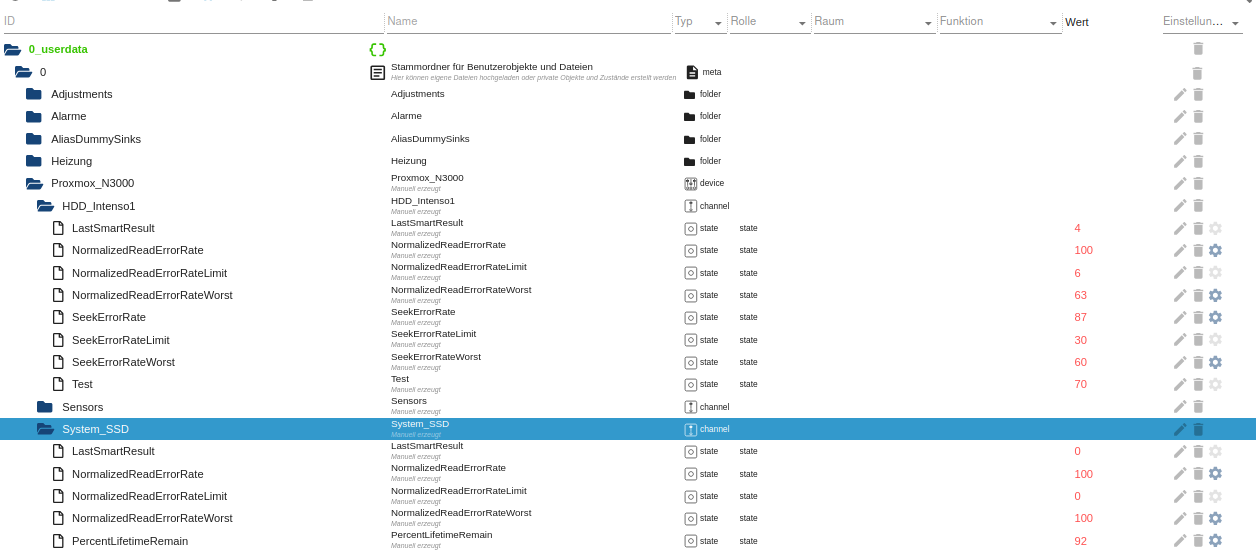
    Hier die Datenpunkte, die ich manuell in Userdata erzeugt habe:
    7d852509-6eea-4fbc-89af-bab5dfcb21b3-grafik.png
    Und das der Eintrag in die root crontab (da man für smartmontools eh sudo braucht... habe aber zumindest die sh Datei readonly gemacht)

    11 */4 * * * bash /root/skripte/check_usb_hdd.sh 2>&1 /dev/null
    

    Intel(R) Celeron(R) CPU N3000 @ 1.04GHz 8G RAM 480G SSD
    Virtualization : unprivileged lxc container (debian 12 on Proxmox 8.4.14)
    Linux pve 6.8.12-16-pve
    6 GByte RAM für den Container
    Fritzbox 6591 FW 8.03 (Vodafone Leih-Box)
    Remote-Access über Wireguard der Fritzbox

    MartinPM OliverIOO 2 Antworten Letzte Antwort
    2
    • MartinPM MartinP

      Ich lese auf dem PVE-Hypervisor Linux per bash script im cron job S.M.A.R.T Parameter der System SSD und einer 4TB USB-HDD ein und schreibe per SimpleAPI einige mir interessant vorkommende Parameter nach "userdata". Alle 4 Stunden zur 11. Minute der Stunde werden die Werte aktualisert.

      S.M.A.R.T Ausgabe meiner USB-HDD


      root@pve:~/skripte# smartctl -a -d sat /dev/sdb
      smartctl 7.3 2022-02-28 r5338 [x86_64-linux-6.8.12-2-pve] (local build)
      Copyright (C) 2002-22, Bruce Allen, Christian Franke, www.smartmontools.org

      === START OF INFORMATION SECTION ===
      Model Family: Seagate BarraCuda 3.5 (SMR)
      Device Model: ST4000DM004-2CV104
      Serial Number: Z9703MW4
      LU WWN Device Id: 5 000c50 0a28fd89c
      Firmware Version: 0001
      User Capacity: 4,000,787,030,016 bytes [4.00 TB]
      Sector Sizes: 512 bytes logical, 4096 bytes physical
      Rotation Rate: 5425 rpm
      Device is: In smartctl database 7.3/5319
      ATA Version is: ACS-3 T13/2161-D revision 5
      SATA Version is: SATA 3.1, 6.0 Gb/s (current: 6.0 Gb/s)
      Local Time is: Mon Sep 30 17:40:12 2024 CEST
      SMART support is: Available - device has SMART capability.
      SMART support is: Enabled

      === START OF READ SMART DATA SECTION ===
      SMART Status command failed: scsi error unsupported scsi opcode
      SMART overall-health self-assessment test result: PASSED
      Warning: This result is based on an Attribute check.

      General SMART Values:
      Offline data collection status: (0x82) Offline data collection activity
      was completed without error.
      Auto Offline Data Collection: Enabled.
      Self-test execution status: ( 0) The previous self-test routine completed
      without error or no self-test has ever
      been run.
      Total time to complete Offline
      data collection: ( 0) seconds.
      Offline data collection
      capabilities: (0x7b) SMART execute Offline immediate.
      Auto Offline data collection on/off support.
      Suspend Offline collection upon new
      command.
      Offline surface scan supported.
      Self-test supported.
      Conveyance Self-test supported.
      Selective Self-test supported.
      SMART capabilities: (0x0003) Saves SMART data before entering
      power-saving mode.
      Supports SMART auto save timer.
      Error logging capability: (0x01) Error logging supported.
      General Purpose Logging supported.
      Short self-test routine
      recommended polling time: ( 1) minutes.
      Extended self-test routine
      recommended polling time: ( 478) minutes.
      Conveyance self-test routine
      recommended polling time: ( 2) minutes.
      SCT capabilities: (0x30a5) SCT Status supported.
      SCT Data Table supported.

      SMART Attributes Data Structure revision number: 10
      Vendor Specific SMART Attributes with ThBildschirmfoto vom 2024-09-30 19-24-36resholds:
      ID# ATTRIBUTE_NAME FLAG VALUE WORST THRESH TYPE UPDATED WHEN_FAILED RAW_VALUE
      1 Raw_Read_Error_Rate 0x000f 081 063 006 Pre-fail Always - 242543912
      3 Spin_Up_Time 0x0003 096 096 000 Pre-fail Always - 0
      4 Start_Stop_Count 0x0032 037 037 020 Old_age Always - 65535
      5 Reallocated_Sector_Ct 0x0033 100 100 010 Pre-fail Always - 0
      7 Seek_Error_Rate 0x000f 087 060 030 Pre-fail Always - 475250992
      9 Power_On_Hours 0x0032 039 039 000 Old_age Always - 54198h+57m+44.554s
      10 Spin_Retry_Count 0x0013 100 100 097 Pre-fail Always - 0
      12 Power_Cycle_Count 0x0032 100 100 020 Old_age Always - 28
      183 Runtime_Bad_Block 0x0032 100 100 000 Old_age Always - 0
      184 End-to-End_Error 0x0032 100 100 099 Old_age Always - 0
      187 Reported_Uncorrect 0x0032 100 100 000 Old_age Always - 0
      188 Command_Timeout 0x0032 100 099 000 Old_age Always - 1 1 1
      189 High_Fly_Writes 0x003a 100 100 000 Old_age Always - 0
      190 Airflow_Temperature_Cel 0x0022 071 049 040 Old_age Always - 29 (Min/Max 25/36)
      191 G-Sense_Error_Rate 0x0032 100 100 000 Old_age Always - 0
      192 Power-Off_Retract_Count 0x0032 100 100 000 Old_age Always - 279
      193 Load_Cycle_Count 0x0032 008 008 000 Old_age Always - 185700
      194 Temperature_Celsius 0x0022 029 051 000 Old_age Always - 29 (0 18 0 0 0)
      195 Hardware_ECC_Recovered 0x001a 084 064 000 Old_age Always - 242543912
      197 Current_Pending_Sector 0x0012 100 100 000 Old_age Always - 0
      198 Offline_Uncorrectable 0x0010 100 100 000 Old_age Offline - 0
      199 UDMA_CRC_Error_Count 0x003e 200 200 000 Old_age Always - 0
      240 Head_Flying_Hours 0x0000 100 253 000 Old_age Offline - 17864h+29m+54.542s
      241 Total_LBAs_Written 0x0000 100 253 000 Old_age Offline - 9900390920
      242 Total_LBAs_Read 0x0000 100 253 000 Old_age Offline - 10644847568

      SMART Error Log Version: 1
      No Errors Logged

      SMART Self-test log structure revision number 1
      No self-tests have been logged. [To run self-tests, use: smartctl -t]

      SMART Selective self-test log data structure revision number 1
      SPAN MIN_LBA MAX_LBA CURRENT_TEST_STATUS
      1 0 0 Not_testing
      2 0 0 Not_testing
      3 0 0 Not_testing
      4 0 0 Not_testing
      5 0 0 Not_testing
      Selective self-test flags (0x0):
      After scanning selected spans, do NOT read-scan remainder of disk.
      If Selective self-test is pending on power-up, resume after 0 minute delay.

      Interessant fand ich da Seek_Error_Rate und Raw_Read_Error_Rate

      Die entsprechenden Zeilen sehen so aus ...

      ID# ATTRIBUTE_NAME          FLAG     VALUE WORST THRESH TYPE      UPDATED  WHEN_FAILED RAW_VALUE
      ...
        1 Raw_Read_Error_Rate     0x000f   081   063   006    Pre-fail  Always       -       242543912
      ...
        7 Seek_Error_Rate         0x000f   087   060   030    Pre-fail  Always       -       475250992
      

      Interessant ist "VALUE", da der Wert "normalisiert ist, gilt, je höher, desto besser Maximum ist 100. Gibt den aktuellen Wert wieder.
      "WORST" ist da schlechteste jemals gemessene Wert.
      "THRESH" ist der Schwellwert, bei dem ein Defekt sehr nahe ist.

      Bei der SSD habe ich erstmal weniger Parameter angedacht, da fehlt womöglich noch etwas.
      An einigen Stellen differieren die Parameter, sodass die angedachte allgemeine Einlese-Funktion nicht möglich ist - schon für diese beiden Platten habe ich individuelle Funktionen bauen müssen...

      Hier die komplette Ausgabe der SSD


      smartctl 7.3 2022-02-28 r5338 [x86_64-linux-6.8.12-2-pve] (local build)
      Copyright (C) 2002-22, Bruce Allen, Christian Franke, www.smartmontools.org

      === START OF INFORMATION SECTION ===
      Model Family: Crucial/Micron Client SSDs
      Device Model: CT480BX500SSD1
      Serial Number: 2248E68B04B2
      LU WWN Device Id: 5 00a075 1e68b04b2
      Firmware Version: M6CR056
      User Capacity: 480,103,981,056 bytes [480 GB]
      Sector Size: 512 bytes logical/physical
      Rotation Rate: Solid State Device
      Form Factor: 2.5 inches
      TRIM Command: Available
      Device is: In smartctl database 7.3/5319
      ATA Version is: ACS-3 T13/2161-D revision 4
      SATA Version is: SATA 3.3, 6.0 Gb/s (current: 6.0 Gb/s)
      Local Time is: Mon Sep 30 15:43:51 2024 CEST
      SMART support is: Available - device has SMART capability.
      SMART support is: Enabled

      === START OF READ SMART DATA SECTION ===
      SMART overall-health self-assessment test result: PASSED

      General SMART Values:
      Offline data collection status: (0x00) Offline data collection activity
      was never started.
      Auto Offline Data Collection: Disabled.
      Self-test execution status: ( 0) The previous self-test routine completed
      without error or no self-test has ever
      been run.
      Total time to complete Offline curl $SimpleApiUrl$1"NormalizedReadErrorRate?value="$(awk '/Raw_Read_Error_Rate/{print $4}' Testdata.txt);
      data collection: ( 120) seconds.
      Offline data collection
      capabilities: (0x11) SMART execute Offline immediate.
      No Auto Offline data collection support.
      Suspend Offline collection upon new
      command.
      No Offline surface scan supported.
      Self-test supported.
      No Conveyance Self-test supported.
      No Selective Self-test supported.
      SMART capabilities: (0x0002) Does not save SMART data before
      entering power-saving mode.
      Supports SMART auto save timer.
      Error logging capability: (0x01) Error logging supported.
      General Purpose Logging supported.
      Short self-test routine
      recommended polling time: ( 2) minutes.
      Extended self-test routine
      recommended polling time: ( 10) minutes.

      SMART Attributes Data Structure revision number: 16
      Vendor Specific SMART Attributes with ThrBildschirmfoto vom 2024-09-30 19-24-36esholds:
      ID# ATTRIBUTE_NAME FLAG VALUE WORST THRESH TYPE UPDATED WHEN_FAILED RAW_VALUE
      1 Raw_Read_Error_Rate 0x002f 100 100 000 Pre-fail Always - 0
      5 Reallocate_NAND_Blk_Cnt 0x0032 100 100 010 Old_age Always - 0
      9 Power_On_Hours 0x0032 100 100 000 Old_age Always - 14036
      12 Power_Cycle_Count 0x0032 100 100 000 Old_age Always - 54
      171 Program_Fail_Count 0x0032 100 100 000 Old_age Always - 0
      172 Erase_Fail_Count 0x0032 100 100 000 Old_age Always - 0
      173 Ave_Block-Erase_Count 0x0032 092 092 000 Old_age Always - 82
      174 Unexpect_Power_Loss_Ct 0x0032 100 100 000 Old_age Always - 37
      180 Unused_Reserve_NAND_Blk 0x0033 100 100 000 Pre-fail Always - 49
      183 SATA_Interfac_Downshift 0x0032 100curl $SimpleApiUrl$1"NormalizedReadErrorRate?value="$(awk '/Raw_Read_Error_Rate/{print $4}' Testdata.txt); 100 000 Old_age Always - 0
      184 Error_Correction_Count 0x0032 100 100 000 Old_age Always - 0
      187 Reported_Uncorrect 0x0032 100 100 000 Old_age Always - 0
      194 Temperature_Celsius 0x0022 068 056 000 Old_age Always - 32 (Min/Max 23/44)
      196 Reallocated_Event_Count 0x0032 100 100 000 Old_age Always - 0
      197 Current_Pending_ECC_Cnt 0x0032 100 100 000 Old_age Always - 0
      198 Offline_Uncorrectable 0x0030 100 100 000 Old_age Offline - 0
      199 UDMA_CRC_Error_Count 0x0032 100 100 000 Old_age Always - 0
      202 Percent_Lifetime_Remain 0x0030 092 092 001 Old_age Offline - 8
      206 Write_Error_Rate 0x000e 100 100 000 Old_age Always - 0
      210 Success_RAIN_Recov_Cnt 0x0032 100 100 000 Old_age Always - 0
      246 Total_LBAs_Written 0x0032 100 100 000 Old_age Always - 12866293454
      247 Host_Program_Page_Count 0x0032 100 100 000 Old_age Always - 402071670
      248 FTL_Program_Page_Count 0x0032 100 100 000 Old_age Always - 320343776
      249 Unkn_CrucialMicron_Attr 0x0032 100 100 000 Old_age Always - 0
      250 Read_Error_Retry_Rate 0x0032 100 100 000 Old_age Always - 0
      251 Unkn_CrucialMicron_Attr 0x0032 100 100 000 Old_age Always - 1625002101
      252 Unkn_CrucialMicron_Attr 0x0032 100 100 000 Old_age Always - 441
      253 Unkn_CrucialMicron_Attr 0x0032 100 100 000 Old_age Always - 0
      254 Unkn_CrucialMicron_Attr 0x0032 100 100 000 Old_age Always - 37
      223 Unkn_CrucialMicron_Attr 0x0032 100 100 000 Old_age Always - 0

      SMART Error Log not supported

      SMART Self-test log structure revision number 1
      No self-tests have been logged. [To run self-tests, use: smartctl -t]

      Selective Self-tests/Logging not supported

      Neben der "Raw_Read_Error_Rate" habe ich nur "VALUE" aus...

      Percent_Lifetime_Remain 0x0030   092   092   001    Old_age   Offline      -       8
      

      .... extrahiert

      Das Bash-Script wird auf dem PVE-System selber ausgeführt

      Erst wird eine Textdatei mit dem Output von Smartctrl erzeugt, dann wird diese passend in der entsprechenden Funktion zerlegt

      # Intenso USB hdd
      smartctl -a -d sat /dev/sdb >Testdata.txt
      write_userdata_hdd "Proxmox_N3000.HDD_Intenso1."
      
      
      # system SSD
      smartctl -a /dev/sda >Testdata.txt
      write_userdata_ssd "Proxmox_N3000.System_SSD."
      

      Hier der ganze Code:

       #!/usr/bin/bash 
      
      
      # to make script ready for cron
      PATH=/usr/local/sbin:/usr/local/bin:/usr/sbin:/usr/bin:/sbin:/bin
      
      
      SimpleApiUrl="http://192.168.2.201:8087/set/0_userdata.0."
      
      
      echo "test_hdd_data.sh drive health check started" > /root/scripte/Proxmox_Skripte/last_run.log
      
      # parameter §1 is subpath (no leading dot but a trailing dot
      function write_userdata_hdd()
      {
        # normalized read error rate
      
        # use simple api to write to iobroker
        # example: http://192.168.1.:8087/set/javascript.0.test?value=1
      
        # ReadErrorRate and ReadErrorRateWorst should be ABOVE ReadErrorRateLimit
        # decreasing distance to limit is an indicator for hdd getting worse 
      
        curl $SimpleApiUrl$1"NormalizedReadErrorRate?value="$(awk '/Raw_Read_Error_Rate/{print $4}' /root/scripte/Proxmox_Skripte/Testdata.txt);
        curl $SimpleApiUrl$1"NormalizedReadErrorRateWorst?value="$(awk '/Raw_Read_Error_Rate/{print $5}' /root/scripte/Proxmox_Skripte/Testdata.txt);
        curl $SimpleApiUrl$1"NormalizedReadErrorRateLimit?value="$(awk '/Raw_Read_Error_Rate/{print $6}' /root/scripte/Proxmox_Skripte/Testdata.txt);
      
        # SeekErrorRate and SeekErrorRateWorst should be ABOVE SeekErrorRateLimit
        # decreasing distance to limit is an indicator for hdd getting worse 
      
        curl $SimpleApiUrl$1"SeekErrorRate?value="$(awk '/Seek_Error_Rate/{print $4}' /root/scripte/Proxmox_Skripte/Testdata.txt);
        curl $SimpleApiUrl$1"SeekErrorRateWorst?value="$(awk '/Seek_Error_Rate/{print $5}' /root/scripte/Proxmox_Skripte/Testdata.txt);
        curl $SimpleApiUrl$1"SeekErrorRateLimit?value="$(awk '/Seek_Error_Rate/{print $6}' /root/scripte/Proxmox_Skripte/Testdata.txt);
        curl $SimpleApiUrl$1"LastSmartResult?value="$2
      
      }


      function write_userdata_ssd()
      {
        # normalized read error rate
      
        # use simple api to write to iobroker
        # example: http://192.168.1.:8087/set/javascript.0.test?value=1
      
        # ReadErrorRate and ReadErrorRateWorst should be ABOVE ReadErrorRateLimit
        # decreasing distance to limit is an indicator for hdd getting worse 
      
        curl $SimpleApiUrl$1"NormalizedReadErrorRate?value="$(awk '/Raw_Read_Error_Rate/{print $4}' /root/scripte/Proxmox_Skripte/Testdata.txt);
        curl $SimpleApiUrl$1"NormalizedReadErrorRateWorst?value="$(awk '/Raw_Read_Error_Rate/{print $5}' /root/scripte/Proxmox_Skripte/Testdata.txt);
        curl $SimpleApiUrl$1"NormalizedReadErrorRateLimit?value="$(awk '/Raw_Read_Error_Rate/{print $6}' /root/scripte/Proxmox_Skripte/Testdata.txt);
      
        # SeekErrorRate and SeekErrorRateWorst should be ABOVE SeekErrorRateLimit
        # decreasing distance to limit is an indicator for hdd getting worse 
      
        curl $SimpleApiUrl$1"PercentLifetimeRemain?value="$(awk '/Percent_Lifetime_Remain/{print $4}' /root/scripte/Proxmox_Skripte/Testdata.txt);
        curl $SimpleApiUrl$1"LastSmartResult?value="$2
      
      }
      
      # write smartctl of hdds of interest to file and analyze results
      
      # for test purpose comment out smartctl invocations and invoke write_userdata_... functions with off script got Testdata.txt
      # even possible on different linux machine
      
      # Intenso USB hdd
      smartctl -a -d sat /dev/sdb >/root/scripte/Proxmox_Skripte/Testdata.txt
      result=$?
      echo " test_hdd_data.sh drive health check data of usb hdd retrieved result="$result >> /root/scripte/Proxmox_Skripte/last_run.log
      
      
      write_userdata_hdd "Proxmox_N3000.HDD_Intenso1." $result
      
      
      # system SSD
      smartctl -a /dev/sda >/root/scripte/Proxmox_Skripte/Testdata.txt
      result=$?
      echo " test_hdd_data.sh drive health check data of system ssd retrieved result="$result >> /root/scripte/Proxmox_Skripte/last_run.log
      write_userdata_ssd "Proxmox_N3000.System_SSD." $result
      
      
      echo " test_hdd_data.sh drive health check finished" >> /root/scripte/Proxmox_Skripte/last_run.log
      

      Hier die Datenpunkte, die ich manuell in Userdata erzeugt habe:

      7d852509-6eea-4fbc-89af-bab5dfcb21b3-grafik.png
      Und das der Eintrag in die root crontab (da man für smartmontools eh sudo braucht... habe aber zumindest die sh Datei readonly gemacht)

      11 */4 * * * bash /root/skripte/check_usb_hdd.sh 2>&1 /dev/null
      
      MartinPM Online
      MartinPM Online
      MartinP
      schrieb am zuletzt editiert von MartinP
      #2

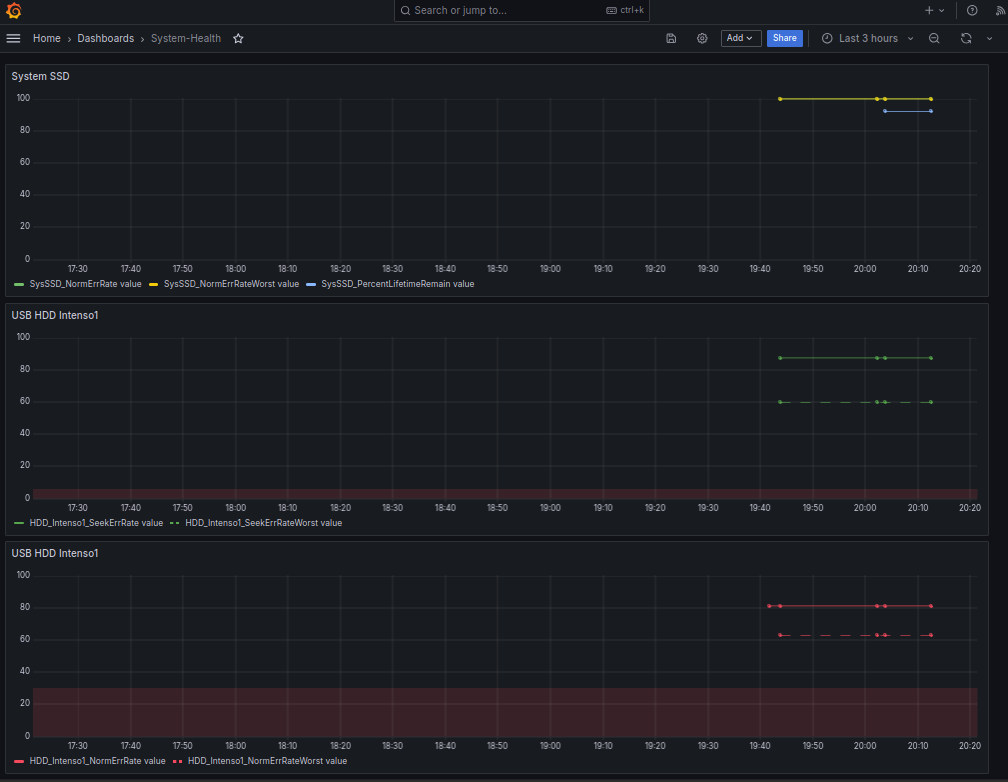
      Hier noch die erste Grafana Auswertung der Messwerte als "Fieberkurven" vielleicht mache ich mir daraus auch noch Gauge-Views, aber da verliert man den Blick auf den "Trend"

      Bei der SSD stehen die Thresholds für Alarm alle auf Null, also habe ich mir da auch nichts eingezeichnet, bei der HDD gibt es für Read-Errors eine Threshold von 6, für Seek-Errors einen von 30 - den habe ich da als roten dünnen Hintergrund dahintergeklemmt
      713cb7d7-4c33-435d-9024-927262f3730f-grafik.png

      Um da nicht vier Stunden auf Messwerte zu warten (wenn Cron mal wieder gefeuert hat), habe ich zwischendurch das Script einige Male von Hand gestartet

      Intel(R) Celeron(R) CPU N3000 @ 1.04GHz 8G RAM 480G SSD
      Virtualization : unprivileged lxc container (debian 12 on Proxmox 8.4.14)
      Linux pve 6.8.12-16-pve
      6 GByte RAM für den Container
      Fritzbox 6591 FW 8.03 (Vodafone Leih-Box)
      Remote-Access über Wireguard der Fritzbox

      1 Antwort Letzte Antwort
      0
      • MartinPM MartinP

        Ich lese auf dem PVE-Hypervisor Linux per bash script im cron job S.M.A.R.T Parameter der System SSD und einer 4TB USB-HDD ein und schreibe per SimpleAPI einige mir interessant vorkommende Parameter nach "userdata". Alle 4 Stunden zur 11. Minute der Stunde werden die Werte aktualisert.

        S.M.A.R.T Ausgabe meiner USB-HDD


        root@pve:~/skripte# smartctl -a -d sat /dev/sdb
        smartctl 7.3 2022-02-28 r5338 [x86_64-linux-6.8.12-2-pve] (local build)
        Copyright (C) 2002-22, Bruce Allen, Christian Franke, www.smartmontools.org

        === START OF INFORMATION SECTION ===
        Model Family: Seagate BarraCuda 3.5 (SMR)
        Device Model: ST4000DM004-2CV104
        Serial Number: Z9703MW4
        LU WWN Device Id: 5 000c50 0a28fd89c
        Firmware Version: 0001
        User Capacity: 4,000,787,030,016 bytes [4.00 TB]
        Sector Sizes: 512 bytes logical, 4096 bytes physical
        Rotation Rate: 5425 rpm
        Device is: In smartctl database 7.3/5319
        ATA Version is: ACS-3 T13/2161-D revision 5
        SATA Version is: SATA 3.1, 6.0 Gb/s (current: 6.0 Gb/s)
        Local Time is: Mon Sep 30 17:40:12 2024 CEST
        SMART support is: Available - device has SMART capability.
        SMART support is: Enabled

        === START OF READ SMART DATA SECTION ===
        SMART Status command failed: scsi error unsupported scsi opcode
        SMART overall-health self-assessment test result: PASSED
        Warning: This result is based on an Attribute check.

        General SMART Values:
        Offline data collection status: (0x82) Offline data collection activity
        was completed without error.
        Auto Offline Data Collection: Enabled.
        Self-test execution status: ( 0) The previous self-test routine completed
        without error or no self-test has ever
        been run.
        Total time to complete Offline
        data collection: ( 0) seconds.
        Offline data collection
        capabilities: (0x7b) SMART execute Offline immediate.
        Auto Offline data collection on/off support.
        Suspend Offline collection upon new
        command.
        Offline surface scan supported.
        Self-test supported.
        Conveyance Self-test supported.
        Selective Self-test supported.
        SMART capabilities: (0x0003) Saves SMART data before entering
        power-saving mode.
        Supports SMART auto save timer.
        Error logging capability: (0x01) Error logging supported.
        General Purpose Logging supported.
        Short self-test routine
        recommended polling time: ( 1) minutes.
        Extended self-test routine
        recommended polling time: ( 478) minutes.
        Conveyance self-test routine
        recommended polling time: ( 2) minutes.
        SCT capabilities: (0x30a5) SCT Status supported.
        SCT Data Table supported.

        SMART Attributes Data Structure revision number: 10
        Vendor Specific SMART Attributes with ThBildschirmfoto vom 2024-09-30 19-24-36resholds:
        ID# ATTRIBUTE_NAME FLAG VALUE WORST THRESH TYPE UPDATED WHEN_FAILED RAW_VALUE
        1 Raw_Read_Error_Rate 0x000f 081 063 006 Pre-fail Always - 242543912
        3 Spin_Up_Time 0x0003 096 096 000 Pre-fail Always - 0
        4 Start_Stop_Count 0x0032 037 037 020 Old_age Always - 65535
        5 Reallocated_Sector_Ct 0x0033 100 100 010 Pre-fail Always - 0
        7 Seek_Error_Rate 0x000f 087 060 030 Pre-fail Always - 475250992
        9 Power_On_Hours 0x0032 039 039 000 Old_age Always - 54198h+57m+44.554s
        10 Spin_Retry_Count 0x0013 100 100 097 Pre-fail Always - 0
        12 Power_Cycle_Count 0x0032 100 100 020 Old_age Always - 28
        183 Runtime_Bad_Block 0x0032 100 100 000 Old_age Always - 0
        184 End-to-End_Error 0x0032 100 100 099 Old_age Always - 0
        187 Reported_Uncorrect 0x0032 100 100 000 Old_age Always - 0
        188 Command_Timeout 0x0032 100 099 000 Old_age Always - 1 1 1
        189 High_Fly_Writes 0x003a 100 100 000 Old_age Always - 0
        190 Airflow_Temperature_Cel 0x0022 071 049 040 Old_age Always - 29 (Min/Max 25/36)
        191 G-Sense_Error_Rate 0x0032 100 100 000 Old_age Always - 0
        192 Power-Off_Retract_Count 0x0032 100 100 000 Old_age Always - 279
        193 Load_Cycle_Count 0x0032 008 008 000 Old_age Always - 185700
        194 Temperature_Celsius 0x0022 029 051 000 Old_age Always - 29 (0 18 0 0 0)
        195 Hardware_ECC_Recovered 0x001a 084 064 000 Old_age Always - 242543912
        197 Current_Pending_Sector 0x0012 100 100 000 Old_age Always - 0
        198 Offline_Uncorrectable 0x0010 100 100 000 Old_age Offline - 0
        199 UDMA_CRC_Error_Count 0x003e 200 200 000 Old_age Always - 0
        240 Head_Flying_Hours 0x0000 100 253 000 Old_age Offline - 17864h+29m+54.542s
        241 Total_LBAs_Written 0x0000 100 253 000 Old_age Offline - 9900390920
        242 Total_LBAs_Read 0x0000 100 253 000 Old_age Offline - 10644847568

        SMART Error Log Version: 1
        No Errors Logged

        SMART Self-test log structure revision number 1
        No self-tests have been logged. [To run self-tests, use: smartctl -t]

        SMART Selective self-test log data structure revision number 1
        SPAN MIN_LBA MAX_LBA CURRENT_TEST_STATUS
        1 0 0 Not_testing
        2 0 0 Not_testing
        3 0 0 Not_testing
        4 0 0 Not_testing
        5 0 0 Not_testing
        Selective self-test flags (0x0):
        After scanning selected spans, do NOT read-scan remainder of disk.
        If Selective self-test is pending on power-up, resume after 0 minute delay.

        Interessant fand ich da Seek_Error_Rate und Raw_Read_Error_Rate

        Die entsprechenden Zeilen sehen so aus ...

        ID# ATTRIBUTE_NAME          FLAG     VALUE WORST THRESH TYPE      UPDATED  WHEN_FAILED RAW_VALUE
        ...
          1 Raw_Read_Error_Rate     0x000f   081   063   006    Pre-fail  Always       -       242543912
        ...
          7 Seek_Error_Rate         0x000f   087   060   030    Pre-fail  Always       -       475250992
        

        Interessant ist "VALUE", da der Wert "normalisiert ist, gilt, je höher, desto besser Maximum ist 100. Gibt den aktuellen Wert wieder.
        "WORST" ist da schlechteste jemals gemessene Wert.
        "THRESH" ist der Schwellwert, bei dem ein Defekt sehr nahe ist.

        Bei der SSD habe ich erstmal weniger Parameter angedacht, da fehlt womöglich noch etwas.
        An einigen Stellen differieren die Parameter, sodass die angedachte allgemeine Einlese-Funktion nicht möglich ist - schon für diese beiden Platten habe ich individuelle Funktionen bauen müssen...

        Hier die komplette Ausgabe der SSD


        smartctl 7.3 2022-02-28 r5338 [x86_64-linux-6.8.12-2-pve] (local build)
        Copyright (C) 2002-22, Bruce Allen, Christian Franke, www.smartmontools.org

        === START OF INFORMATION SECTION ===
        Model Family: Crucial/Micron Client SSDs
        Device Model: CT480BX500SSD1
        Serial Number: 2248E68B04B2
        LU WWN Device Id: 5 00a075 1e68b04b2
        Firmware Version: M6CR056
        User Capacity: 480,103,981,056 bytes [480 GB]
        Sector Size: 512 bytes logical/physical
        Rotation Rate: Solid State Device
        Form Factor: 2.5 inches
        TRIM Command: Available
        Device is: In smartctl database 7.3/5319
        ATA Version is: ACS-3 T13/2161-D revision 4
        SATA Version is: SATA 3.3, 6.0 Gb/s (current: 6.0 Gb/s)
        Local Time is: Mon Sep 30 15:43:51 2024 CEST
        SMART support is: Available - device has SMART capability.
        SMART support is: Enabled

        === START OF READ SMART DATA SECTION ===
        SMART overall-health self-assessment test result: PASSED

        General SMART Values:
        Offline data collection status: (0x00) Offline data collection activity
        was never started.
        Auto Offline Data Collection: Disabled.
        Self-test execution status: ( 0) The previous self-test routine completed
        without error or no self-test has ever
        been run.
        Total time to complete Offline curl $SimpleApiUrl$1"NormalizedReadErrorRate?value="$(awk '/Raw_Read_Error_Rate/{print $4}' Testdata.txt);
        data collection: ( 120) seconds.
        Offline data collection
        capabilities: (0x11) SMART execute Offline immediate.
        No Auto Offline data collection support.
        Suspend Offline collection upon new
        command.
        No Offline surface scan supported.
        Self-test supported.
        No Conveyance Self-test supported.
        No Selective Self-test supported.
        SMART capabilities: (0x0002) Does not save SMART data before
        entering power-saving mode.
        Supports SMART auto save timer.
        Error logging capability: (0x01) Error logging supported.
        General Purpose Logging supported.
        Short self-test routine
        recommended polling time: ( 2) minutes.
        Extended self-test routine
        recommended polling time: ( 10) minutes.

        SMART Attributes Data Structure revision number: 16
        Vendor Specific SMART Attributes with ThrBildschirmfoto vom 2024-09-30 19-24-36esholds:
        ID# ATTRIBUTE_NAME FLAG VALUE WORST THRESH TYPE UPDATED WHEN_FAILED RAW_VALUE
        1 Raw_Read_Error_Rate 0x002f 100 100 000 Pre-fail Always - 0
        5 Reallocate_NAND_Blk_Cnt 0x0032 100 100 010 Old_age Always - 0
        9 Power_On_Hours 0x0032 100 100 000 Old_age Always - 14036
        12 Power_Cycle_Count 0x0032 100 100 000 Old_age Always - 54
        171 Program_Fail_Count 0x0032 100 100 000 Old_age Always - 0
        172 Erase_Fail_Count 0x0032 100 100 000 Old_age Always - 0
        173 Ave_Block-Erase_Count 0x0032 092 092 000 Old_age Always - 82
        174 Unexpect_Power_Loss_Ct 0x0032 100 100 000 Old_age Always - 37
        180 Unused_Reserve_NAND_Blk 0x0033 100 100 000 Pre-fail Always - 49
        183 SATA_Interfac_Downshift 0x0032 100curl $SimpleApiUrl$1"NormalizedReadErrorRate?value="$(awk '/Raw_Read_Error_Rate/{print $4}' Testdata.txt); 100 000 Old_age Always - 0
        184 Error_Correction_Count 0x0032 100 100 000 Old_age Always - 0
        187 Reported_Uncorrect 0x0032 100 100 000 Old_age Always - 0
        194 Temperature_Celsius 0x0022 068 056 000 Old_age Always - 32 (Min/Max 23/44)
        196 Reallocated_Event_Count 0x0032 100 100 000 Old_age Always - 0
        197 Current_Pending_ECC_Cnt 0x0032 100 100 000 Old_age Always - 0
        198 Offline_Uncorrectable 0x0030 100 100 000 Old_age Offline - 0
        199 UDMA_CRC_Error_Count 0x0032 100 100 000 Old_age Always - 0
        202 Percent_Lifetime_Remain 0x0030 092 092 001 Old_age Offline - 8
        206 Write_Error_Rate 0x000e 100 100 000 Old_age Always - 0
        210 Success_RAIN_Recov_Cnt 0x0032 100 100 000 Old_age Always - 0
        246 Total_LBAs_Written 0x0032 100 100 000 Old_age Always - 12866293454
        247 Host_Program_Page_Count 0x0032 100 100 000 Old_age Always - 402071670
        248 FTL_Program_Page_Count 0x0032 100 100 000 Old_age Always - 320343776
        249 Unkn_CrucialMicron_Attr 0x0032 100 100 000 Old_age Always - 0
        250 Read_Error_Retry_Rate 0x0032 100 100 000 Old_age Always - 0
        251 Unkn_CrucialMicron_Attr 0x0032 100 100 000 Old_age Always - 1625002101
        252 Unkn_CrucialMicron_Attr 0x0032 100 100 000 Old_age Always - 441
        253 Unkn_CrucialMicron_Attr 0x0032 100 100 000 Old_age Always - 0
        254 Unkn_CrucialMicron_Attr 0x0032 100 100 000 Old_age Always - 37
        223 Unkn_CrucialMicron_Attr 0x0032 100 100 000 Old_age Always - 0

        SMART Error Log not supported

        SMART Self-test log structure revision number 1
        No self-tests have been logged. [To run self-tests, use: smartctl -t]

        Selective Self-tests/Logging not supported

        Neben der "Raw_Read_Error_Rate" habe ich nur "VALUE" aus...

        Percent_Lifetime_Remain 0x0030   092   092   001    Old_age   Offline      -       8
        

        .... extrahiert

        Das Bash-Script wird auf dem PVE-System selber ausgeführt

        Erst wird eine Textdatei mit dem Output von Smartctrl erzeugt, dann wird diese passend in der entsprechenden Funktion zerlegt

        # Intenso USB hdd
        smartctl -a -d sat /dev/sdb >Testdata.txt
        write_userdata_hdd "Proxmox_N3000.HDD_Intenso1."
        
        
        # system SSD
        smartctl -a /dev/sda >Testdata.txt
        write_userdata_ssd "Proxmox_N3000.System_SSD."
        

        Hier der ganze Code:

         #!/usr/bin/bash 
        
        
        # to make script ready for cron
        PATH=/usr/local/sbin:/usr/local/bin:/usr/sbin:/usr/bin:/sbin:/bin
        
        
        SimpleApiUrl="http://192.168.2.201:8087/set/0_userdata.0."
        
        
        echo "test_hdd_data.sh drive health check started" > /root/scripte/Proxmox_Skripte/last_run.log
        
        # parameter §1 is subpath (no leading dot but a trailing dot
        function write_userdata_hdd()
        {
          # normalized read error rate
        
          # use simple api to write to iobroker
          # example: http://192.168.1.:8087/set/javascript.0.test?value=1
        
          # ReadErrorRate and ReadErrorRateWorst should be ABOVE ReadErrorRateLimit
          # decreasing distance to limit is an indicator for hdd getting worse 
        
          curl $SimpleApiUrl$1"NormalizedReadErrorRate?value="$(awk '/Raw_Read_Error_Rate/{print $4}' /root/scripte/Proxmox_Skripte/Testdata.txt);
          curl $SimpleApiUrl$1"NormalizedReadErrorRateWorst?value="$(awk '/Raw_Read_Error_Rate/{print $5}' /root/scripte/Proxmox_Skripte/Testdata.txt);
          curl $SimpleApiUrl$1"NormalizedReadErrorRateLimit?value="$(awk '/Raw_Read_Error_Rate/{print $6}' /root/scripte/Proxmox_Skripte/Testdata.txt);
        
          # SeekErrorRate and SeekErrorRateWorst should be ABOVE SeekErrorRateLimit
          # decreasing distance to limit is an indicator for hdd getting worse 
        
          curl $SimpleApiUrl$1"SeekErrorRate?value="$(awk '/Seek_Error_Rate/{print $4}' /root/scripte/Proxmox_Skripte/Testdata.txt);
          curl $SimpleApiUrl$1"SeekErrorRateWorst?value="$(awk '/Seek_Error_Rate/{print $5}' /root/scripte/Proxmox_Skripte/Testdata.txt);
          curl $SimpleApiUrl$1"SeekErrorRateLimit?value="$(awk '/Seek_Error_Rate/{print $6}' /root/scripte/Proxmox_Skripte/Testdata.txt);
          curl $SimpleApiUrl$1"LastSmartResult?value="$2
        
        }


        function write_userdata_ssd()
        {
          # normalized read error rate
        
          # use simple api to write to iobroker
          # example: http://192.168.1.:8087/set/javascript.0.test?value=1
        
          # ReadErrorRate and ReadErrorRateWorst should be ABOVE ReadErrorRateLimit
          # decreasing distance to limit is an indicator for hdd getting worse 
        
          curl $SimpleApiUrl$1"NormalizedReadErrorRate?value="$(awk '/Raw_Read_Error_Rate/{print $4}' /root/scripte/Proxmox_Skripte/Testdata.txt);
          curl $SimpleApiUrl$1"NormalizedReadErrorRateWorst?value="$(awk '/Raw_Read_Error_Rate/{print $5}' /root/scripte/Proxmox_Skripte/Testdata.txt);
          curl $SimpleApiUrl$1"NormalizedReadErrorRateLimit?value="$(awk '/Raw_Read_Error_Rate/{print $6}' /root/scripte/Proxmox_Skripte/Testdata.txt);
        
          # SeekErrorRate and SeekErrorRateWorst should be ABOVE SeekErrorRateLimit
          # decreasing distance to limit is an indicator for hdd getting worse 
        
          curl $SimpleApiUrl$1"PercentLifetimeRemain?value="$(awk '/Percent_Lifetime_Remain/{print $4}' /root/scripte/Proxmox_Skripte/Testdata.txt);
          curl $SimpleApiUrl$1"LastSmartResult?value="$2
        
        }
        
        # write smartctl of hdds of interest to file and analyze results
        
        # for test purpose comment out smartctl invocations and invoke write_userdata_... functions with off script got Testdata.txt
        # even possible on different linux machine
        
        # Intenso USB hdd
        smartctl -a -d sat /dev/sdb >/root/scripte/Proxmox_Skripte/Testdata.txt
        result=$?
        echo " test_hdd_data.sh drive health check data of usb hdd retrieved result="$result >> /root/scripte/Proxmox_Skripte/last_run.log
        
        
        write_userdata_hdd "Proxmox_N3000.HDD_Intenso1." $result
        
        
        # system SSD
        smartctl -a /dev/sda >/root/scripte/Proxmox_Skripte/Testdata.txt
        result=$?
        echo " test_hdd_data.sh drive health check data of system ssd retrieved result="$result >> /root/scripte/Proxmox_Skripte/last_run.log
        write_userdata_ssd "Proxmox_N3000.System_SSD." $result
        
        
        echo " test_hdd_data.sh drive health check finished" >> /root/scripte/Proxmox_Skripte/last_run.log
        

        Hier die Datenpunkte, die ich manuell in Userdata erzeugt habe:

        7d852509-6eea-4fbc-89af-bab5dfcb21b3-grafik.png
        Und das der Eintrag in die root crontab (da man für smartmontools eh sudo braucht... habe aber zumindest die sh Datei readonly gemacht)

        11 */4 * * * bash /root/skripte/check_usb_hdd.sh 2>&1 /dev/null
        
        OliverIOO Offline
        OliverIOO Offline
        OliverIO
        schrieb am zuletzt editiert von OliverIO
        #3

        @martinp

        ChatGPT sag mir, dass diese Parameter wichtig sind

        Dein SSD-Status zeigt, dass die SMART-Gesundheitsprüfung bestanden wurde. Hier sind die wichtigsten Punkte:

        1. Gesundheitszustand: „PASSED“ (keine Probleme erkannt).
        2. Betriebsstunden: 14.036 Stunden.
        3. Restleben: 92 % (das bedeutet, dass die SSD noch eine gute Lebensdauer hat).
        4. Reallocated Blocks: 0 (keine fehlerhaften Blöcke).
        5. Temperatur: 32 °C (normal).

        Insgesamt sieht es so aus, als ob deine SSD gut funktioniert. Du solltest regelmäßig Backups machen und die SMART-Werte im Auge behalten.

        Meine Adapter und Widgets
        TVProgram, SqueezeboxRPC, OpenLiga, RSSFeed, MyTime,, pi-hole2, vis-json-template, skiinfo, vis-mapwidgets, vis-2-widgets-rssfeed
        Links im Profil

        MartinPM 1 Antwort Letzte Antwort
        0
        • OliverIOO OliverIO

          @martinp

          ChatGPT sag mir, dass diese Parameter wichtig sind

          Dein SSD-Status zeigt, dass die SMART-Gesundheitsprüfung bestanden wurde. Hier sind die wichtigsten Punkte:

          1. Gesundheitszustand: „PASSED“ (keine Probleme erkannt).
          2. Betriebsstunden: 14.036 Stunden.
          3. Restleben: 92 % (das bedeutet, dass die SSD noch eine gute Lebensdauer hat).
          4. Reallocated Blocks: 0 (keine fehlerhaften Blöcke).
          5. Temperatur: 32 °C (normal).

          Insgesamt sieht es so aus, als ob deine SSD gut funktioniert. Du solltest regelmäßig Backups machen und die SMART-Werte im Auge behalten.

          MartinPM Online
          MartinPM Online
          MartinP
          schrieb am zuletzt editiert von MartinP
          #4

          @oliverio Hatte noch Probleme, dass das Script zwar aus der Console gestartet gelaufen ist, aber aus dem cron nicht funktioniert hat ...

          Nach Internetrecherche kriegt die Shell anscheinend nicht alle ENV-Einträge der normalen Umgebung

          Mit "env" kann man sich das anschauen

          Crontab-Eintrag, um zu schauen, wie das Env im cron aussieht:

          * * * * * env >mist.env
          

          mist.env

          HOME=/root
          LOGNAME=root
          PATH=/usr/bin:/bin
          LANG=en_US.UTF-8
          SHELL=/bin/sh
          PWD=/root
          

          env aus der konsole

          SHELL=/bin/bash
          PWD=/root
          LOGNAME=root
          XDG_SESSION_TYPE=tty
          MOTD_SHOWN=pam
          HOME=/root
          LANG=en_US.UTF-8
          XDG_SESSION_CLASS=user
          TERM=xterm-256color
          USER=root
          SHLVL=1
          XDG_SESSION_ID=19428
          XDG_RUNTIME_DIR=/run/user/0
          HUSHLOGIN=FALSE
          PATH=/usr/local/sbin:/usr/local/bin:/usr/sbin:/usr/bin:/sbin:/bin
          DBUS_SESSION_BUS_ADDRESS=unix:path=/run/user/0/bus
          MAIL=/var/mail/root
          _=/usr/bin/env
          OLDPWD=/root/scripte/Proxmox_Skripte
          

          habe mir den PATH aus der Konsole in das Bash Script an den Anfang kopiert und jetzt läuft das Script auch aus dem cron

          Neueste Version, mit Auswertung des Rückgabewertes habe ich im obersten Beitrag abgelegt, das alte Listing ersetzt

          Intel(R) Celeron(R) CPU N3000 @ 1.04GHz 8G RAM 480G SSD
          Virtualization : unprivileged lxc container (debian 12 on Proxmox 8.4.14)
          Linux pve 6.8.12-16-pve
          6 GByte RAM für den Container
          Fritzbox 6591 FW 8.03 (Vodafone Leih-Box)
          Remote-Access über Wireguard der Fritzbox

          MartinPM 1 Antwort Letzte Antwort
          0
          • MartinPM MartinP

            @oliverio Hatte noch Probleme, dass das Script zwar aus der Console gestartet gelaufen ist, aber aus dem cron nicht funktioniert hat ...

            Nach Internetrecherche kriegt die Shell anscheinend nicht alle ENV-Einträge der normalen Umgebung

            Mit "env" kann man sich das anschauen

            Crontab-Eintrag, um zu schauen, wie das Env im cron aussieht:

            * * * * * env >mist.env
            

            mist.env

            HOME=/root
            LOGNAME=root
            PATH=/usr/bin:/bin
            LANG=en_US.UTF-8
            SHELL=/bin/sh
            PWD=/root
            

            env aus der konsole

            SHELL=/bin/bash
            PWD=/root
            LOGNAME=root
            XDG_SESSION_TYPE=tty
            MOTD_SHOWN=pam
            HOME=/root
            LANG=en_US.UTF-8
            XDG_SESSION_CLASS=user
            TERM=xterm-256color
            USER=root
            SHLVL=1
            XDG_SESSION_ID=19428
            XDG_RUNTIME_DIR=/run/user/0
            HUSHLOGIN=FALSE
            PATH=/usr/local/sbin:/usr/local/bin:/usr/sbin:/usr/bin:/sbin:/bin
            DBUS_SESSION_BUS_ADDRESS=unix:path=/run/user/0/bus
            MAIL=/var/mail/root
            _=/usr/bin/env
            OLDPWD=/root/scripte/Proxmox_Skripte
            

            habe mir den PATH aus der Konsole in das Bash Script an den Anfang kopiert und jetzt läuft das Script auch aus dem cron

            Neueste Version, mit Auswertung des Rückgabewertes habe ich im obersten Beitrag abgelegt, das alte Listing ersetzt

            MartinPM Online
            MartinPM Online
            MartinP
            schrieb am zuletzt editiert von MartinP
            #5

            Interessanterweise gibt es bei der USB-HDD einen Returncode !=0

            Bei der SSD kommt immer eine 0 (alles O.K.) als "result" zurück, bei der HDD eine 4... also Bit 2 gesetzt ...

            ich vermute, aufgrund der folgenden Fehlermeldung mit anschließender Warnung

            ...
            === START OF READ SMART DATA SECTION ===
            SMART Status command failed: scsi error unsupported scsi opcode
            SMART overall-health self-assessment test result: PASSED
            Warning: This result is based on an Attribute check.
            ....
            
            smartctl -a /dev/sda >/root/scripte/Proxmox_Skripte/Testdata.txt
            result=$?
            

            Das bedeutet laut untenstehendem ...

            Return Values

            The return values of smartctl are defined by a bitmask. If all is well with the disk, the return value (exit status) of smartctl is 0 (all bits turned off). If a problem occurs, or an error, potential error, or fault is detected, then a non-zero status is returned. In this case, the eight different bits in the return value have the following meanings for ATA disks; some of these values may also be returned for SCSI disks.

            Bit 0:

            Command line did not parse.

            Bit 1:

            Device open failed, device did not return an IDENTIFY DEVICE structure, or device is in a low-power mode (see '-n' option above).

            Bit 2:

            Some SMART or other ATA command to the disk failed, or there was a checksum error in a SMART data structure (see '-b' option above).

            Bit 3:

            SMART status check returned "DISK FAILING".

            Bit 4:

            We found prefail Attributes <= threshold.

            Bit 5:

            SMART status check returned "DISK OK" but we found that some (usage or prefail) Attributes have been <= threshold at some time in the past.

            Bit 6:

            The device error log contains records of errors.

            Bit 7:

            The device self-test log contains records of errors. [ATA only] Failed self-tests outdated by a newer successful extended self-test are ignored.
            To test within the shell for whether or not the different bits are turned on or off, you can use the following type of construction (this is bash syntax):

            smartstat=$(($? & 8))

            This looks at only at bit 3 of the exit status $? (since 8=2^3). The shell variable $smartstat will be nonzero if SMART status check returned "disk failing" and zero otherwise.

            This bash script prints all status bits:

            status=$?
            for ((i=0; i<8; i++)); do
            echo "Bit $i: $((status & 2**i && 1))"
            done
            Intel(R) Celeron(R) CPU N3000 @ 1.04GHz 8G RAM 480G SSD
            Virtualization : unprivileged lxc container (debian 12 on Proxmox 8.4.14)
            Linux pve 6.8.12-16-pve
            6 GByte RAM für den Container
            Fritzbox 6591 FW 8.03 (Vodafone Leih-Box)
            Remote-Access über Wireguard der Fritzbox

            1 Antwort Letzte Antwort
            0
            Antworten
            • In einem neuen Thema antworten
            Anmelden zum Antworten
            • Älteste zuerst
            • Neuste zuerst
            • Meiste Stimmen


            Support us

            ioBroker
            Community Adapters
            Donate

            903

            Online

            32.6k

            Benutzer

            82.0k

            Themen

            1.3m

            Beiträge
            Community
            Impressum | Datenschutz-Bestimmungen | Nutzungsbedingungen | Einwilligungseinstellungen
            ioBroker Community 2014-2025
            logo
            • Anmelden

            • Du hast noch kein Konto? Registrieren

            • Anmelden oder registrieren, um zu suchen
            • Erster Beitrag
              Letzter Beitrag
            0
            • Home
            • Aktuell
            • Tags
            • Ungelesen 0
            • Kategorien
            • Unreplied
            • Beliebt
            • GitHub
            • Docu
            • Hilfe